


Let’s examine the first principles, first.
The New Monetary Physics
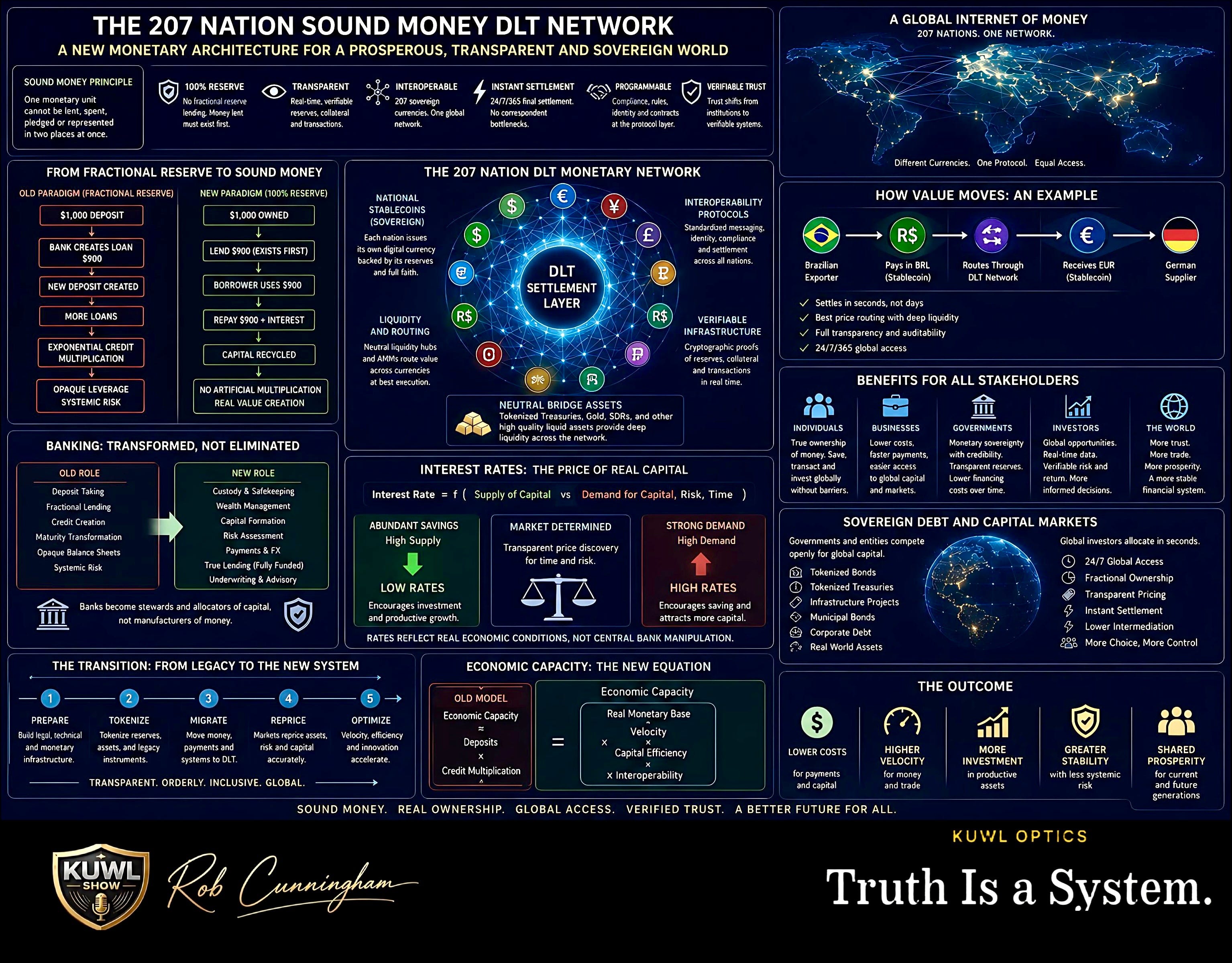
Assume 207 sovereign nations simultaneously operate on interoperable DLT-based sound money, with each nation willing and able to issue a sovereign digital currency or stablecoin, but with a radical constraint:
A monetary unit cannot be lent, spent, pledged, or represented as available money in two places at once.
That single rule - codified as “The GENUIS Act” in America in 2025 - changes almost everything.
Under fractional-reserve banking, a $1,000 deposit can become the foundation for additional bank-created credit. In our emerging monetary system, $1,000 is $1,000. Banks cannot manufacture another spendable deposit merely by booking a loan.
Credit does not disappear. Its architecture changes.
A bank, fund, corporation, individual, pension plan, sovereign wealth fund, or decentralized liquidity pool could still lend money. But the capital being lent would have to exist first. If I lend you $100,000, I give up control of that $100,000 for the contractual period. The ledger makes the transfer, collateral, maturity, interest obligations, ownership and repayment mathematically inspectable.
So instead of:
Deposits → fractional multiplication → opaque leverage → more money claims
you get:
Savings/capital → explicit lending → productive deployment → repayment → capital recycled
That is an enormous distinction.
Now connect all 207 nations
Imagine:
207 sovereign currencies/stablecoins
common DLT settlement standards
cryptographic proof of reserves
real-time settlement
transparent collateral
programmable compliance
interoperable liquidity
no fractional-reserve money creation**
You have effectively created a Global Internet of Money.
The dollar does not have to disappear. Neither does the euro, yen, peso, pound, rupee or riyal.
Instead, currencies become digitally interoperable instruments.
A Brazilian company could possess BRL, buy machinery from Germany priced in EUR, obtain financing from Singaporean capital, provide tokenized Brazilian assets as collateral, and settle the transaction through neutral liquidity infrastructure - potentially within seconds.
The revolutionary element is that the countries don’t need to share one currency. They only need to share interoperable monetary physics.
The balance sheet becomes king
This would move enormous importance away from who can create credit toward who actually possesses productive capital.
Countries would compete increasingly on things such as:
reserves + commodities + productivity + fiscal discipline + legal integrity + human capital + productive assets + credible monetary governance.
A badly governed country could still issue currency.
But it would become much harder to hide monetary deterioration behind an opaque banking multiplier.
Markets could continuously price the credibility of its currency against hundreds of other monetary assets.
That introduces something extraordinary:
Monetary competition at Internet speed.
Citizens and businesses will be free to move away from poorly managed monetary instruments toward better ones without waiting for the legacy correspondent-banking infrastructure.
Banking survives - but becomes profoundly different
Banks can become exceptionally valuable.
But their primary function will move closer to:
custody
wealth management
capital formation
underwriting
risk assessment
payments
foreign exchange
escrow
trade finance
asset management
true lending
rather than earning extraordinary leverage from the privilege of expanding deposit money, aka “fractional reserve lending.”
The difference is subtle but profound.
The bank becomes primarily a steward and allocator of capital rather than a manufacturer of monetary claims.
Depositors could choose explicitly between:
Custody: “Keep my $1 million completely available.”
and
Investment/lending: “I authorize $600,000 to be placed into these loans for this return and this risk.”
No pretending that the same money is simultaneously completely liquid to the depositor and substantially committed elsewhere.
Interest rates acquire a different meaning
This may be one of the biggest consequences.
Without fractional creation of bank credit, the price of capital increasingly becomes determined by:
How much real capital is available versus how badly borrowers want it.
Suppose the world has enormous savings.
Interest rates could be extremely low because capital is abundant.
Suppose investment demand explodes.
Rates rise, encouraging additional saving and attracting additional capital.
The interest rate therefore becomes much closer to a genuine market-clearing price for time and risk, via supply and demand, rather than a number heavily mediated by leveraged bank balance sheets and central-bank liquidity operations.
Then add DLT transparency
Now the monetary system becomes continuously reconcilable.
Money issued = money outstanding
Collateral pledged = collateral verifiably encumbered
Treasury reserves = independently inspectable reserves
Loans = identifiable contractual claims
Settlement = final transfer of value
Currency supply = mathematically auditable
That doesn’t eliminate fraud, corruption, defaults or bad judgment.
But it dramatically shrinks the domain in which accounting ambiguity itself allows those problems to remain concealed.
And this produces perhaps the most important philosophical transition:
Trust the institution
becomes
verify the system.
Now imagine 207 sovereign stablecoins
This is where the model becomes especially interesting.
The world could have a monetary network resembling the Internet:
National currencies = websites/domains
DLTs = networks
Interoperability protocols = TCP/IP
Stablecoins = packets of sovereign value
Neutral bridge assets = routing liquidity
Tokenized Treasuries/RWAs = collateral layer
Smart contracts = executable financial agreements
Cryptographic proofs = monetary receipts
And global liquidity could continuously route (via AMMs) toward the cheapest, safest and most efficient path.
You don’t necessarily need one world currency.
You need a universal way for different forms of value to communicate.
The consequence for sovereign debt is fascinating
Governments would still need financing.
But instead of simply depending upon monetary expansion downstream of the banking system, they would compete openly for global capital.
Imagine tokenized U.S. Treasury securities available around the world 24/7.
France competes.
Japan competes.
Saudi Arabia competes.
Brazil competes.
Corporations compete.
Infrastructure projects compete.
Even municipalities could compete.
A saver sitting in Korea might allocate capital across twenty nations in seconds.
Capital therefore becomes vastly more sovereign at the individual level while simultaneously becoming vastly more global at the network level.
And capital velocity will explode
Eliminating fractional reserves does not necessarily mean shrinking economic activity.
That is crucial.
The same unit of legitimate capital can settle repeatedly.
If $1 million settles once every three business days in an old system, its economic usefulness is limited.
If DLT enables that same $1 million to be safely deployed, settled, released and redeployed many times in one day, enormous economic throughput becomes possible without multiplying claims against the underlying money.
That gives us a radically different equation:
Old model: increase leverage to increase monetary capacity.
versus
New model: increase velocity, interoperability and capital efficiency to increase monetary capacity.
That may be the central breakthrough.
Put the entire model into one equation
The new system substitutes technology-driven efficiency for balance-sheet-driven monetary multiplication.
The Biggest Beautiful Outcome
If all 207 nations actually adopted this architecture, humanity could move from a monetary system fundamentally organized around credit expansion and institutional trust toward one increasingly organized around:
real assets, true abundance, explicit risk, verifiable ownership, transparent reserves, genuine savings, instantaneous settlement and interoperable sovereign value.
Money would still represent human agreement.
Credit would still involve risk.
Currencies would still rise and fall.
Governments could still mismanage themselves.
People could still make terrible investments.
But the monetary infrastructure itself becomes dramatically harder to manipulate invisibly.
And that brings us to the truly enormous second stage of this model:
What happens to the roughly hundreds of trillions of dollars of existing global bank assets, sovereign debt, derivatives, real estate, equities, pensions and collateral when this system switches on?
That is where this new era infrastructure becomes really consequential - because we can model the transition from the legacy leveraged monetary stock into a 207-sovereign-currency, fully reserved DLT system, including what happens to bank balance sheets, interest rates, asset prices, Treasury demand, gold, and neutral bridge liquidity.
I hate to be the predictor of bad news but it's going to give those banks and bankers even more power and authority to create a crisis than they have had up to this point. They own in all likely hood 90+% of all the liquid cash and control, in one way or another, probably 97% of the unencumbered assets that exist. How is anyone going to prevent them taking control of the 3% that remains. Our money will be even less liquid than it is now. They will buy up every insolvent company and properties for pennies on the dollar much easier than they did in the 1930's.
Brilliant as always, Rob